Migration

Soon birds will be moving north from their winter homes. Time to revisit some friends in Florida. First, a red-tailed hawk keeping eye on a dragonfly.

Red-tailed hawk and dragonfly in scrub pine

Red-tailed hawk and dragonfly in scrub pine

That image and the next are both from the reclaimed areas around a water treatment facility that’s become a good home for wildlife. Here’s a White Ibis flying by.

Ibis over Viera Wetlands

Ibis over Viera Wetlands

Down in the water is a Tri-color Heron, also called a Louisiana Heron.

Tri-color Heron

Tri-color Heron

Finally, a couple reflections of a Snowy Egret showing off its yellow slippers. Snowies came very close to extinction in the early 20th century when their feathers were harvested for hats.

snowy_MG_9477.jpg
Snowy egret at St. Augustine Alligator Farm

Snowy egret at St. Augustine Alligator Farm

Narrowed

Last week I mentioned I’d wanted to do an extended essay on the Zion Narrows trail , but hadn’t worked on the images. I took so many images, it still took me a long time to narrow down and then process a few. As mentioned before, the first mile of the trail is an easy paved hike from the end of the canyon road, and even wheelchair accessible for a good part of the way. After the trail ends, you need to hike in the Virgin River to continue up the canyon. I would guess in the blazing summer heat, it’s great to get in. January is a bit different. Fortunately, several outfitters in Springdale, a small community right outside the park entrance, will equip you. I had excellent results with the appropriately named Zion Outfitter, who let me have the equipment the day before at no extra charge so I could get an early start on the hike. The gear included neoprene socks to keep your feet warm, canyoneering boots to walk on the slippery rocks, and dry pants and bibs to keep you dry in the deeper water. And what was most essential—a sturdy walking stick to feel the water depth, where footing might be and keep you upright on slippery rocks in the heavy current. There are a few areas where there are rocks on the side of the canyon that you can get out of the water and walk on.

Fern wall, Zion Narrows

Fern wall, Zion Narrows

Rocky shore

Rocky shore

However, most of the hike is just in water with canyon walls on both sides. The images look calm, and I expected a fairly easy hike. It turned out to be quite strenuous. While the water looks calm, it flows at a vigorous rate that you have to push against going upstream. While it looks clear, the flow and glare don’t allow you to see most steps, so you need to place every footstep carefully on a solid area before going on to the next step. I was using very different muscles for this kind of hike, and they let me know that night!

3041 green water.jpg

But there are so many spots to just stop and soak in the view.

Coves and stones

Coves and stones

Wall art

Wall art

Canyon wall tree

Canyon wall tree

Zion is a place of so many contrasts. In the red rock desert, the Virgin River and tributaries are oasis of lush growth. In a frozen January, with snow and ice on the walls, water drips among ferns.

Ice and shower

Ice and shower

In a few weeks, the spring thaw will close this hike because the water will be too high. In summer, the trail will be closed when storms are nearby because water will funnel into the canyon and there will be no safe space in the flash flood. The many images I’ve seen of summer hiking has the canyon filled with people since Zion is now the third most visited park. But on this January day, I didn’t see another person for the first two and a half hours, and saw just a dozen people all day enjoying the solitude of this wonder.

3313 warm land paul crop.jpg

Zion Narrows

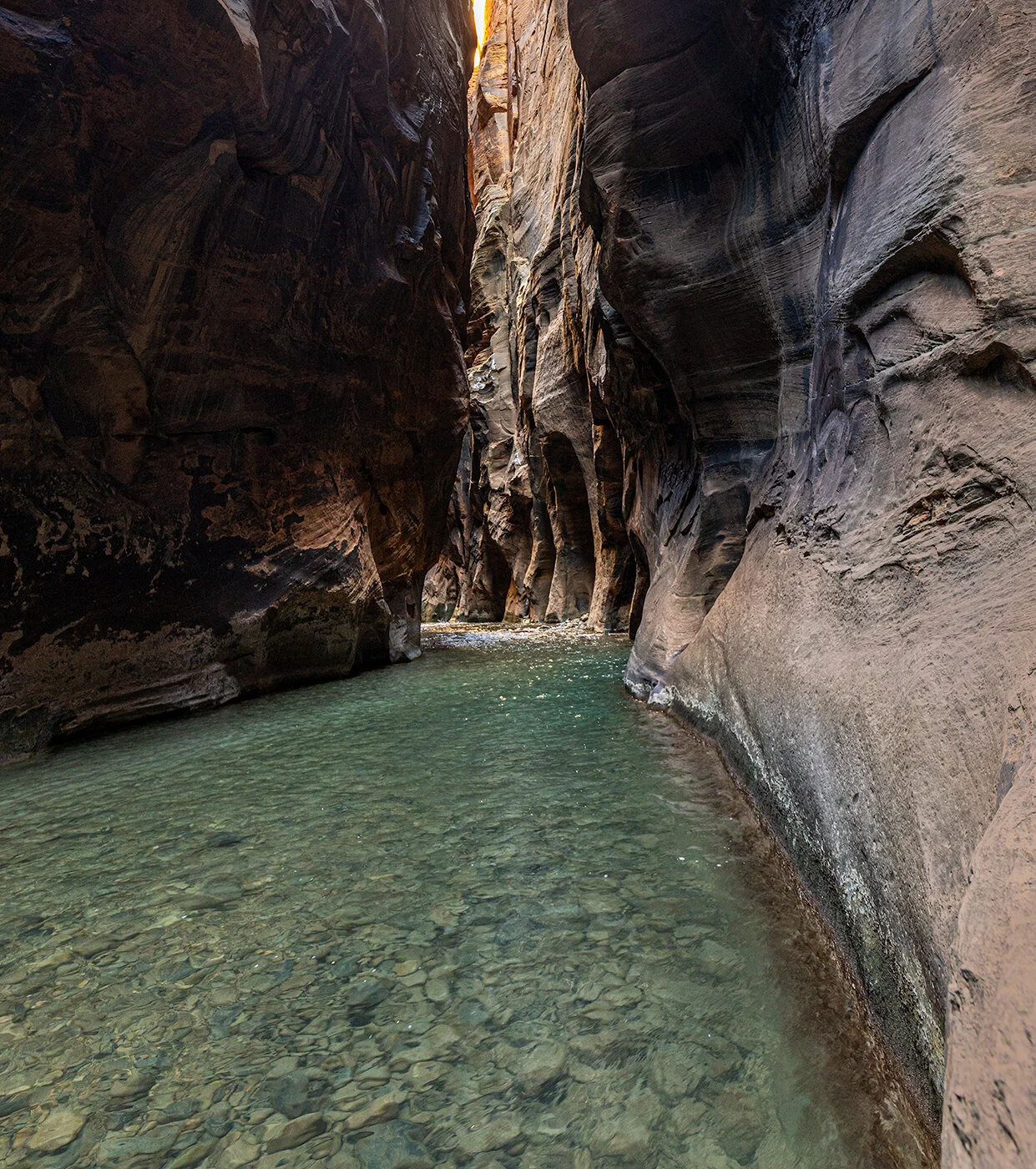
On Tuesday, I wrote about the Zion Narrows River Trail which goes for about a mile upstream along the Virgin River. At the end of that trail, you must hike in the river to go further upstream. The canyon narrows even more. In January, you need to wear neoprene boots and rubberized pants to stay warm. I’d hoped to post more images of the hike, but Friday got away from me, and I did want to share one image. Due to its narrowness, sunlight doesn’t get into the canyon walls until near noon. Then for a short while the walls glow in the canyon light.

Zion Narrows Canyon, Zion National Park, Utah

Zion Narrows Canyon, Zion National Park, Utah

Seaing horses, dragons and pipes

On Tuesday I posted about the Chicago Shedd Aquarium. Few creatures there are more captivating than sea horses. Indeed, sea horse images are all around the building in the plaster, tile, and even yard tall cornices. However, before even seeing any sea horses, I ran across this delightful little fellow called a pipefish, which the display said is in the same family as sea horses. It has a single fin—in the back—for propulsion, same type snout, and the female also lays eggs in the male who then fertilizes and carries them.

sea pipe-4884  Syngnathinae Shedd Aquarium
pipefish pano-4674.jpg

I can’t remember why, but it seems fascinating that the next creature belongs to the genus Hippocampus. Unlike the other two relatives, the Longsnout Seahorse has a prehensile tail to grab onto plants and other structures.

Longsnout sea horse-5129  Syngnathinae hippocampus reidi
sea horse dark-5140 Chicago Shedd Aquarium.jpg

Stealing the show is this little Aussie, the Leafy Seadragon. Like the sea horse, it moves around by its dorsal fin. The leafy appendages are just for disguise, though it too does have those little pectoral fins on the neck for balance and turning.

Common Seadragon, Phyllopteryx taeniolatus sea dragon pano-4991.jpg
Chicago Shedd Aquarium sea dragon-5523.jpg

West of Zion

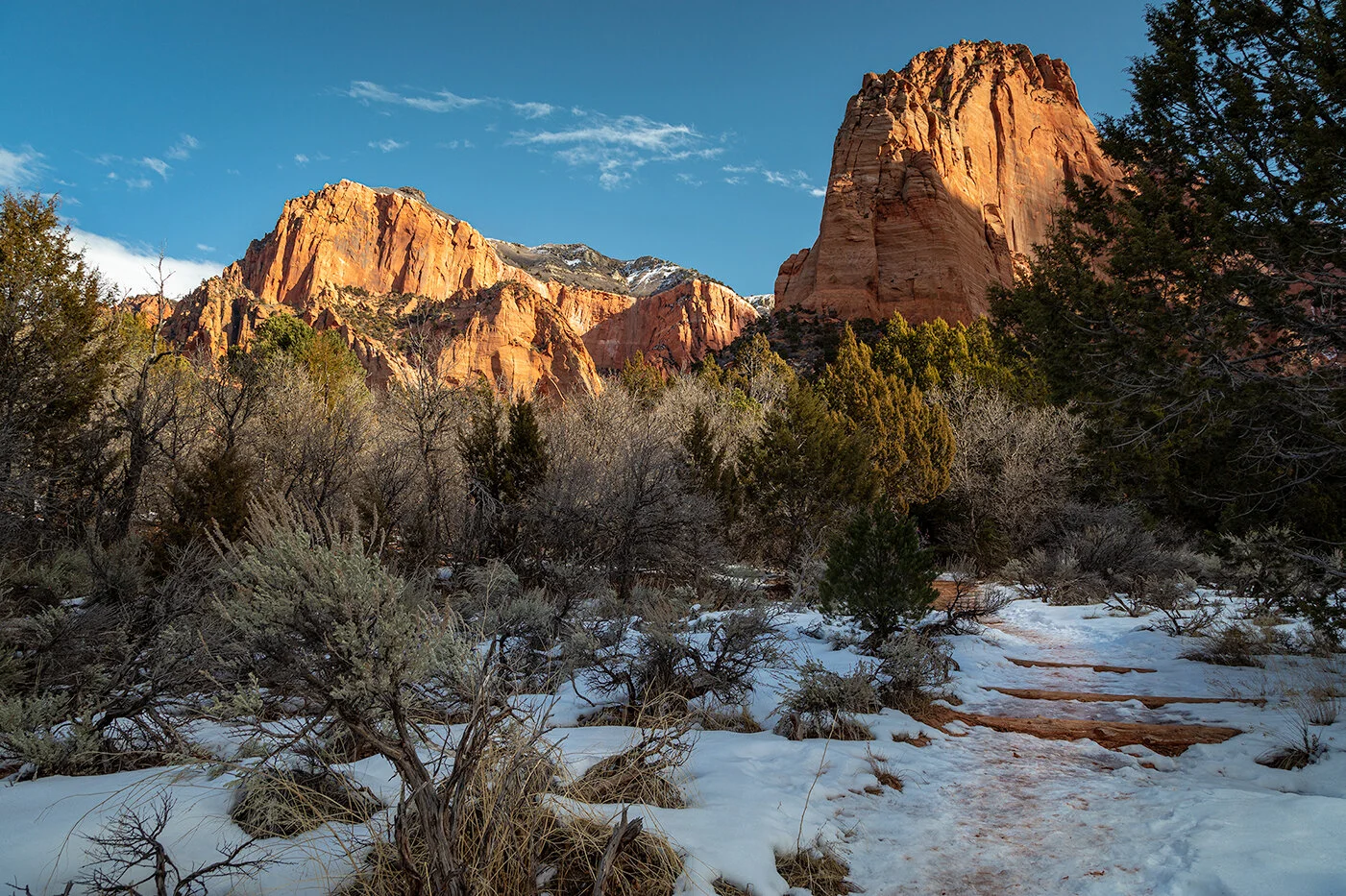
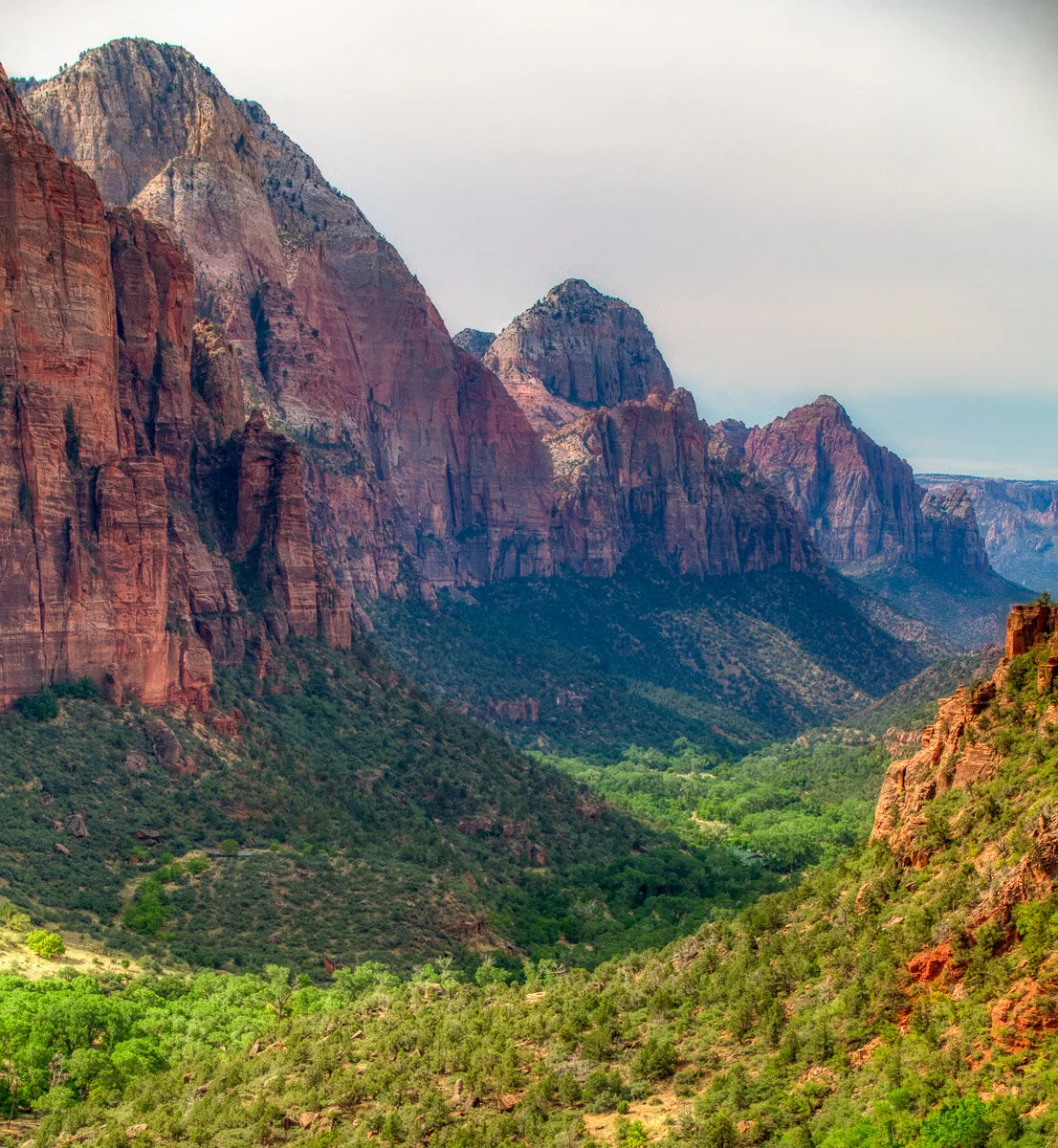
Last week I posted about the east side of Zion National Park, which connects to Zion Valley by road. Zion is now the 3rd most visited National Park, and most visitors are concentrated in the central Zion valley. During much of the year, you need to ride the excellent shuttle bus system to get into the valley. Ironically though, an area just off an I-15 exit, Kolob Canyon in the northwest part of the park, is much less visited. You can’t see this from the interstate, but a short drive behind a ridgeline offers a magnificent view.

Timber Top Mountain, Zion National Park, Utah

Timber Top Mountain, Zion National Park, Utah

The Kolob Canyon area was first protected as Zion National Monument in 1937, and incorporated into the National Park in 1956. The view above is the southern edge of the sandstone monoliths, and the view below looks further north. These peaks reach over 8,000 feet.

Kolob Canyon panorama

Kolob Canyon panorama

Creeks have carved valleys as these rocks reach out like fingers. On the far left of the image above, Taylor Creek has created a meandering path into the Zion wilderness.

Taylor Creek

Taylor Creek

Taylor Creek trail

Taylor Creek trail

The trail cuts back and forth across the creek which presents some slippery hiking in January, but also presents wonderful ice displays.

ice-3658.jpg
creek-3670.jpg
ice crystals-3667.jpg

I’ve never seen ice formation like the last one above. They were a mass of fragile, flaky forms carpeting above the creek. Don’t know if it was morning fog or steam rising over the water during the night or some other cause, but they’d crumble with a touch. When returning on the trail by early afternoon, they’d collapsed into mush. A small waterfall presented itself in the glow off the red sandstone.

Taylor Creek aglow

Taylor Creek aglow

I was also surprised by the number of birds in southern Utah in January. Not the avian variety in this image, but a couple of love birds.

Dan and Melina

Dan and Melina

I wrote Tuesday about the continued assault on the protections of this land by the current administration. Yesterday, half of Grand Staircase-Escalante National Monument, protected since 1996, was open to oil and gas drilling and exploration. Best summarized by the National Resources Defense Council:

“These plans are atrocious, and entirely predictable,” said Sharon Buccino, senior director for lands at the Natural Resources Defense Council. “They are the latest in a series of insults to these magnificent lands by the Trump administration.”

East of Zion

The central valley of Zion National Park is dominated by red and white sandstone monoliths. Driving east from the valley the road goes through the more than mile long Zion-Mt. Carmel tunnel. Built nearly a century ago, the tunnel is not large enough for many vehicles, so traffic must stop at times to allow wider or taller vehicles to drive through the center of the tunnel. At this higher elevation, there are wider views of wonderfully patterned sandstone. However, at the east side of the tunnel is a scenic trail that leads to a view back into the valley. In the second image below, you can see the road winding up in the shade to the tunnel.

East Rim trail view into a slot canyon

East Rim trail view into a slot canyon

East Zion Canyon view

East Zion Canyon view

The red sandstone and green trees and shrubs provide peaceful, but dramatic views.

Moonrise near sunset

Moonrise near sunset

Lone pine

Lone pine

Aside from the East Rim Trail, this side of the park has no designated trails. However, there are wonderful sites just a few steps off the road.

East side canyon

East side canyon

canyon pool

canyon pool

Nice views of the white Navajo sandstone which provides the identification of the White Cliffs of the Grand Staircase.

White Cliffs

White Cliffs

And you might get a delightful surprise of some wildlife. Two juvenile bald eagles played above the road, but no images of them beyond our memories. However, some mountain sheep posed for pictures before running off.

Bighorn sheep

Bighorn sheep

running away

running away

No snow in Snow Canyon

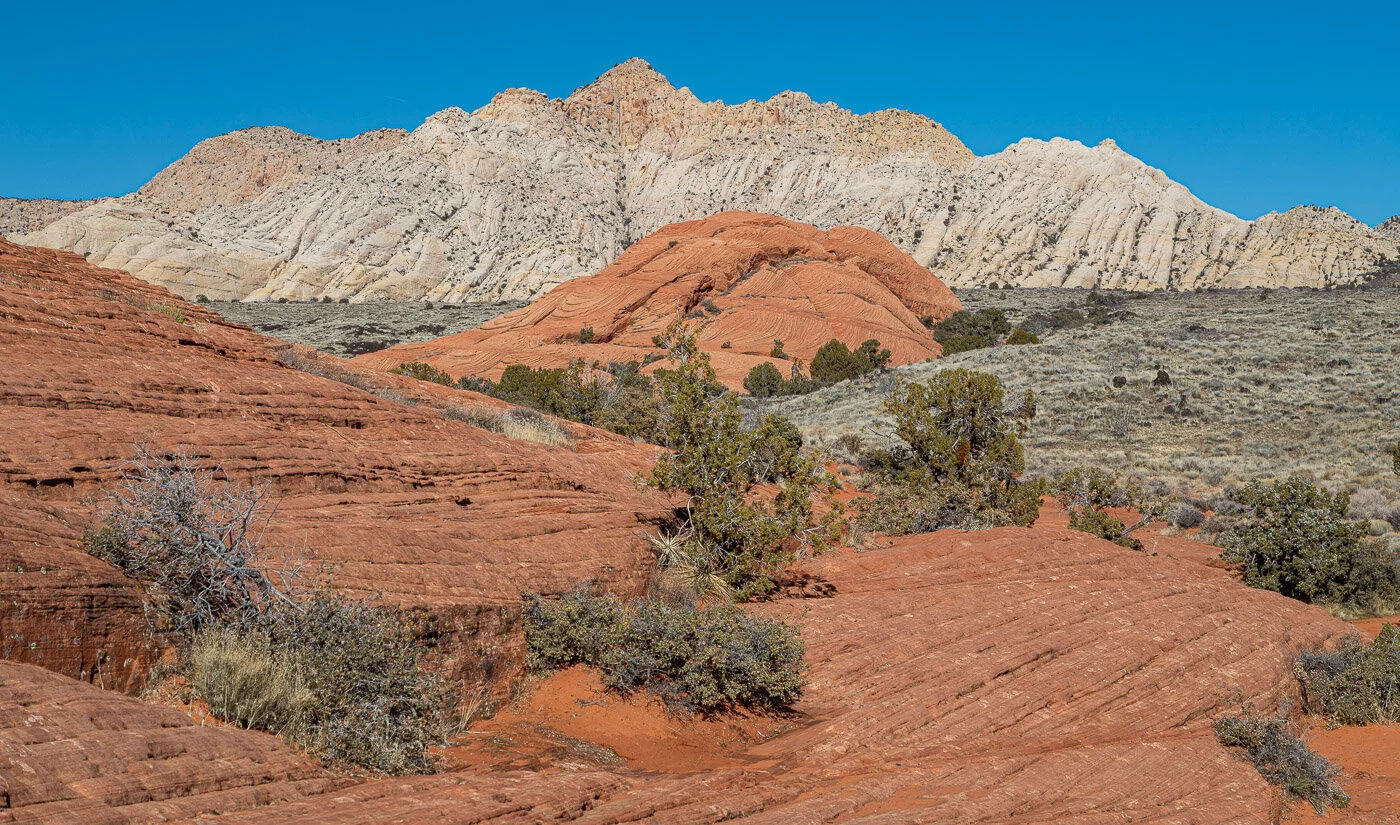
It’s not that it never snows in Utah’s Snow Canyon State Park, but it is rare. Water in any form is rare with less than 8 inches of rain a year. Mormon settlers in the 1850s called this sunny area in the Mohave dessert “Dixie,” hoping to grow cotton and other crops. Dixie State University still is in nearby St. George, and the park was first known as Dixie State Park. It was later renamed for Mormon settler brothers Lorenzo and Erastus Snow.

White Rocks Amphitheater, Snow Canyon State Park, Utah

White Rocks Amphitheater, Snow Canyon State Park, Utah

The white and red Navajo Sandstone was desert sand dunes 180 million years ago. One trail goes through an area aptly called Petrified Dunes.

Petrified Dunes

Petrified Dunes

There was a tiny pocket of water, and the folks on top of one dune give a sense of scale.

Reflected dune

Reflected dune

The moon has kept watch over the area when this was desert sand dunes, lava flows, and now carved out frozen dunes. A piece of the lava that once covered the area before it was eroded away sits on top the dune in second image below.

Snow Canyon petrified dunes moon pano-.jpg
Snow Canyon petrified dunes moon-2876.jpg

Bryce in winter

At 9,000 feet elevation, there’s a good chance a January visit to Bryce National Park will provide snow. We were lucky that roads were open as well as most trails, and a sunny day made hiking comfortable.

Rim Trail view, Bryce National Park, Utah

Rim Trail view, Bryce National Park, Utah

One of the best trails anywhere is a loop along the edge of the cliff, and then down into the hoodoos on Queens Garden trail, and after a walk along the pines on the floor, back up on Navajo Trail.

Hoodoos on Queens Garden Trail

Hoodoos on Queens Garden Trail

Another advantage of winter hiking, is that even when it is close to noon, the sun stays low in the southern sky, and you get nice light. On the hike, I said even when I look at the images later, I’ll say the colors couldn’t have been that intense. They were.

Sunburst on a hoodoo

Sunburst on a hoodoo

Bryce hoodoo-3291.jpg

Bryce has the largest concentration of hoodoos in the world. It is visiting a fairy tale world.

Bryce panorama view

Bryce panorama view

Leaving the park required another stop to look park at the winter scene. Bryce is on the final level of the Colorado Plateau’s Grand Staircase. Climbing up from the Grand Canyon are the giant stairsteps of the Chocolate Cliffs, Vermilion Cliffs, White, Gray, and finally the Pink Cliffs in which Bryce sits.

Sevier River and the Pink Cliffs of Grand Staircase

Sevier River and the Pink Cliffs of Grand Staircase

Watchman

If you’re a fan of the HBO Watchman series or the graphic novel, sorry this post is not about that. At the south end of Zion canyon stands an imposing pyramid-shaped mountain keeping watch over the valley. At the intersection where the state highway heads east and the road splits for the only route into the valley, a bridge crosses the Virgin River that carved the valley. There is no walkway on the bridge, just the two lanes of traffic and narrow concrete edges where photographers gather every sunset for the iconic shot of the Watchman over the Virgin River and the cottonwood tree. I was there this evening, not with the big summer crowd, but with several others lined across the bridge with our tripods hoping the promising sky would provide a show.

Watchman, Zion National Park, Utah

Watchman, Zion National Park, Utah

As the sun got low, some orange light started to shine on the red sandstone low on the ridges, and then spread to the peak nearby and then up the Watchman.

Sunset

Sunset

Then the show ended with a flourish. One of the clouds emptied some rain which caught the sunlight like some golden fingers of the artist finishing the painting.

The end of the show

The end of the show

Angels land here

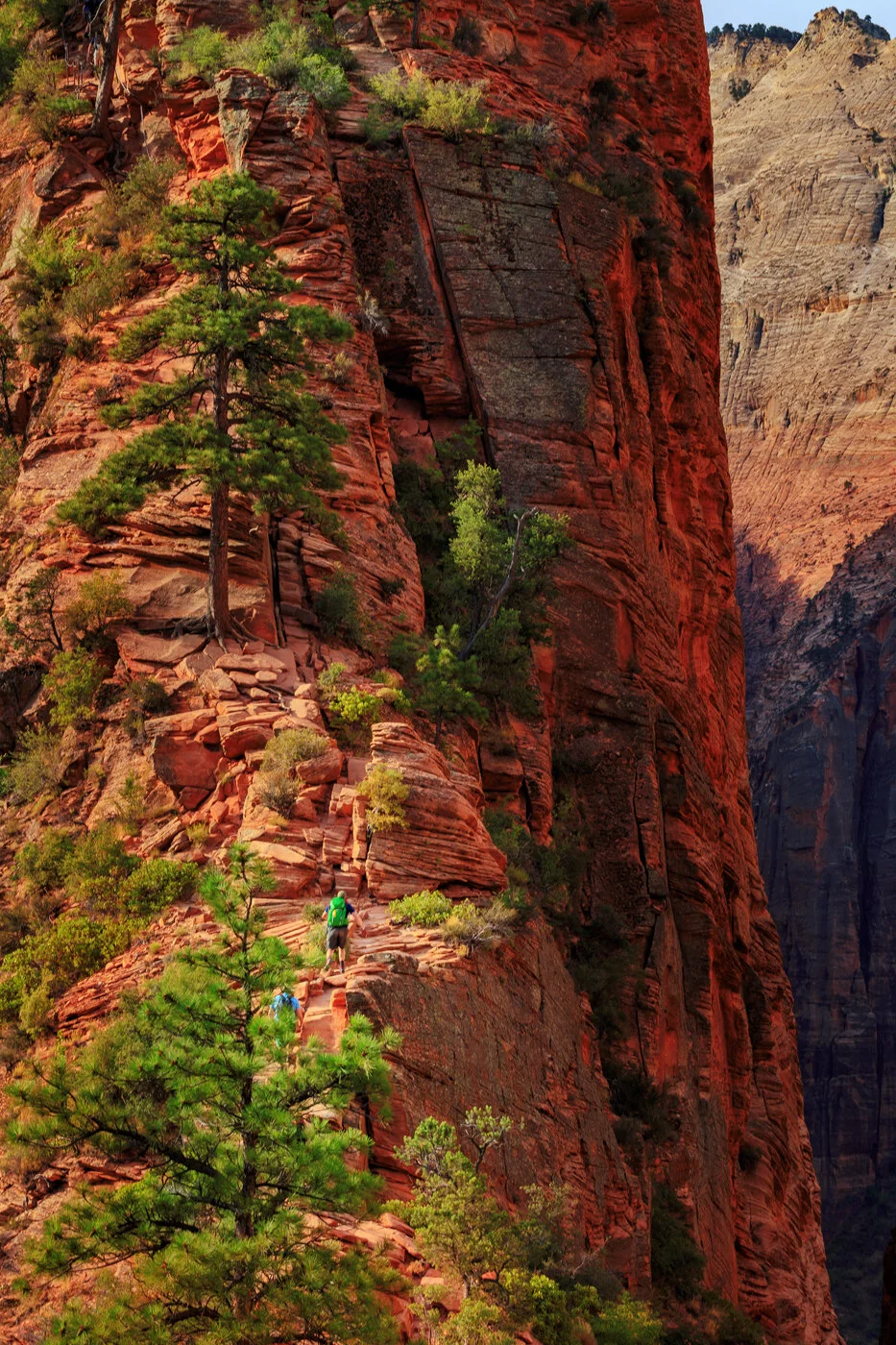
Zion National Park has become the third most visited park after Great Smokies and Grand Canyon, and most visitors funnel into the one way in and out Zion valley. Most of the year you can’t drive into the valley and instead ride the excellent shuttle buses that stop along the road. However, in January you can drive in, but even then, if you don’t arrive early, parking near popular trails fill up quickly. One of the most popular hikes, and for good reason is Angels Landing trail. You start in the valley floor by crossing the Virgin River that carved the valley, looking up the tip of Angels Landing 1,500 feet up.

Angels Landing

Angels Landing

The trail gently rises up the valley floor until you start long switch backs up one cliff side. Can you spot hikers on the far left, in the middle, and other near the top right on the trail?

Angels trail 1702.jpg

At that spot on the top right of the image above, you get a nice view of the valley. From there, you go back into a hanging valley called Refrigerator Canyon.

A view from above

A view from above

Looking down to where you’ve been so far

Looking down to where you’ve been so far

Up Refrigerator Canyon

Up Refrigerator Canyon

Then you get to the engineering feat that made this trail possible—Walter’s Wiggles. Walter Ruesch, the first park superintendent directed that this series of switchbacks be constructed to allow “easy” access to Angels Landing.

Walter’s Wiggles

Walter’s Wiggles

You then arrive at Scout Lookout where people gather before the final ascent or to take other trails or simply to enjoy the view here. A little way further up some chains with a sheer drop of hundreds of feet on either side of the trail provides an even better view into the valley.

CMD Angles Landing victory-.jpg

Angels Landing is another half mile up with drops of a thousand feet on both sides of the trail. A hiker coming down said there was ice on the trail which made it “interesting.” We decided to head down and take a hike on the West Rim trail where we got a nice view of the trail up Angels Landing. Maybe you can see the tiny hikers on the trail of the second image below with Angels Landing on the left.

DM Angles Landing climb-.jpg
Angels Landing -.jpg

Park Number 62

One week ago today, legislation was enacted to create our 62nd national park. White Sands National Monument was upgraded to National Park status and will get greater funding and protections. I visited the Monument several years ago. After revisiting these images, I want to go back! Let’s start with some classic black and white views. The graphic textures of the dunes fit well with black and white.

White Sands National Park, New Mexico

White Sands National Park, New Mexico

Ripples

Ripples

The park is in the Chihuahuan Desert, but water is essential to keep the sand dunes. The park is surrounded by mountain ranges, and gypsum ran down from the mountains into the ancient lake that covered the area in the last ice age. When it evaporated, a dry lake bed, or playa, of gypsum remained. The dunes grew since the surrounding mountains kept the sand inside, and the crystals eroded to even smaller, whiter pieces. The water below the dunes helps keep the sands adhering and not blow away. Little Lake Lucero fills and evaporates adding more gypsum to the dunes.

Lake Lucero

Lake Lucero

The white sands also soak up the color of the sky, and the New Mexico desert offers great color at the beginning and end of the day. The plants send out long roots to be stable in the dune field and to soak up the little water.

Sunset amid yucca and Indian rice grass

Sunset amid yucca and Indian rice grass

The vast, undulating dunes are disorienting, and it is easy to lose track of where you’ve been, and more importantly, where the car was parked!

359 sunset pano white sands (1 of 1).jpg

Of course, I wanted to be back to capture the dawn color, but the park gates don’t open until after sunrise. However, you can pay to have a ranger open the gates early! I ran into another photographer who agreed to split the costs, and we arranged to meet the ranger at the gate before first light. It was well worth it.

Dawn with crescent moon

Dawn with crescent moon

The Soaptree Yucca is the most common plant in the dunes. Indians used all parts of the plant for food, fibers and, as its name indicates—soap.

North of the park, the dunes continue into the White Sands Missile Range. Last week the Starlliner capsule landed there after testing. Next year it will take astronauts to the space station. The park sometimes closes because of the missile testing, and at the far north end of the range, Trinity Site was where the first atomic bomb was detonated.

Soaptree Yucca

Soaptree Yucca

As the sun got up, and the magic color was going away, a bit of golden light offered the last images of the visit.

Cottonwood morning

Cottonwood morning

End of the day

Some days offer unexpected gifts. I’ve posted images from one of those days in four posts already. I was looking forward to a quick trip to Golden Spike National Historical Site, see the place a momentous event occurred and head back to the big city. I was greeted with an amazing sunrise hike on the historic rail bed, viewed the beautiful reconstructed steam engines, diverted to a mysterious hike on the salt lake, crossed vast ranch land, witnessed beautiful shadowplay on an ancient arch, and I thought the day gave all its rewards. It hadn’t.

Pintail Lake

Pintail Lake

The sky was continuing to give a show on the return drive. The map showed some lakes ahead just off the road, so perhaps some nice reflections could be found. The Bear River flows into the northeast part of the great lake, and much of the area is protected waterfowl habitat. I still don’t know what this area was despite searching on the web, but I did get lake names. The view above looks back west to the Promontory Mountains.

Wigeon Lake

Wigeon Lake

A hint of red touched the clouds briefly, and quickly faded.

Wigeon Lake dusk

Wigeon Lake dusk

And the notes played quietly to end the day.

1309 bear river wigeon lake pano.jpg

Geologic timing

One of the most challenging concepts to comprehend is time, especially vast passages. The Great Salt Lake, huge as it is, is only a remnant of ancient Lake Bonneville which covered much of present Utah as well as into Nevada and Idaho. If we could time travel back 15,000 years, in the image below I would’ve been standing on the shore of the lake looking across to the shoreline where the sun is streaking across the Promontory Mountains in the distance. Geologists say a natural dam collapsed in Idaho, and a flood so massive occurred that it may have taken a year to drain Lake Bonneville.

Golden Spike National Historical Park sunset

Golden Spike National Historical Park sunset

I was exploring a bit of Golden Spike National Historical Park while enjoying the evening light display. I pulled over for a short hike to Chinese Arch, named to commemorate a large part of the workforce that built the railroad. Over 11,000 Chinese workers labored on the Central Pacific rail line from Sacramento digging tunnels and building up tracks.

Compared to the massive natural arches in southern Utah, this limestone formation is puny, but it can help you make that time travel back 15,000 years. The waves of Lake Bonneville washed against the shoreline here and eroded the rock. The arch likely would not have lasted too long and been fully eroded by the waves had the lake not disappeared. But now you can stand on this rock and look down imaging the lake waves rolling against the arch below.

Chinese Arch and the ancient Lake Bonneville lake bed

Chinese Arch and the ancient Lake Bonneville lake bed

I didn’t realize the light show I was about to be gifted with. The sun was appearing and disappearing with the cloud cover, and golden light would shine on the rocks and then go away. The sun was going below the ridge behind me, but providing a nice show as it sank.

Chinese Arch glow

Chinese Arch glow

Then I noticed even more magic. Do you see the hint in the image above?

I saw the arch was casting its shadow on the land below. On what would’ve been lake water. I got an invite to a natural Stonehenge show. It must only be a couple times a year that the sun angle will show the full shadow of the arch. And then only for a few minutes as the sun gets low in the sky and before it goes behind the ridge. And then there must not be clouds to cover the sun. What an event to stumble upon.

Arch shadow

Arch shadow

A dash of salt

I’ve visited Salt Lake City five times, but had never been to the shore of the Great Salt Lake. The airport rests on the edge of the lake and the flight approach often goes over the lake. The Natural History Museum of Utah has a terrific exhibit on the ecology, hydrology and geography of the lake. When I visited Golden Spike National Historical Park, there were signs for a drive over ranch land to the Spiral Jetty. It was mid-day—not a good time for photography usually, but my curiosity prevailed, and it was time to visit the lake.

Spiral Jetty, Great Salt Lake, Utah

Spiral Jetty, Great Salt Lake, Utah

Standing on the ridge above the lake, it looks like a weird mirage of mountains in the distance. It is odd to smell the salt air as if you’re on the ocean coast. The 1,500 foot long, 15 foot wide jetty coils out from the shore. It is sometimes submerged under water, but the lake is low and so the water was quite a distance from the jetty built in 1970 by sculptor Robert Smithson.

It gets stranger walking past the jetty to the lake. The north arm of the Great Salt Lake was cut off from the rest of the lake when a train causeway was built by the Southern Pacific Railroad. The ocean is about 3.5% salinity. Most of this lake is about three times saltier. The north arm has a 27% salinity! Red salt-tolerant bacteria and algae and a few weird insects live in the water.
Red water reflections

Red water reflections

The small islands and the ripples in the shallow, red water enhance the other-worldly feel.

Sunburst, Great Salt Lake

Sunburst, Great Salt Lake

Comma

Comma

GSL north arm islands (1 of 1).jpg

What in the distance looks like salt or ice crystals near the edge of the water, turn out to be mats of foam and bubbles. The very slow waves and surge of the lake cause the foam mats to shutter and sputter and act like some primordial life coming out of the lake. I was very happy the hikers in the distance wore red jackets.

Salt foam

Salt foam

Hikers looking at foam forms

Hikers looking at foam forms

My shoes still have some salt marks from this odd hike to this weird, huge desert lake.

Islands and mirages

Islands and mirages

North Arm reflections

North Arm reflections

Appetizer

The hamlet of Fionnphort sits on the western edge of the southern arm of the Island of Mull—called the Ross of Mull. The ferry leaves Fionnphort for the short trip across to the island of Iona. My B-and-B proprietor suggested I walk next door to make a reservation for dinner at The Keel Row. I reserved the last available time hoping I could get some sunset images before dinner, and I took my camera across the road to the cove that looked over to Iona. Low tide beached a boat in the mud.

Fionnphort beach, Isle of Mull

Fionnphort beach, Isle of Mull

Walking further down the wet sand to beach to view the red granite across the cove catching the sunset light.

Fionnphort cove -2.jpg

Fionnphort means white sands or white port, but as the tide went out the ripples looked quite dark.

View across to Iona

View across to Iona

Time to walk back up to the top of the cove and get a final shot before dinner.

Fionnphort sunset over Iona

Fionnphort sunset over Iona

Angels

I’m looking forward to a visit to Zion National Park in Utah this winter, and getting a different view of this wonder. One trail I likely won’t be taking this time is Angel’s Landing, one of the most magnificent hikes in the National Parks. The trail starts by crossing the Virgin River in the valley floor.

Virgin River, Zion National Park

Virgin River, Zion National Park

Soon you are gaining elevation on switchbacks and slow ascents, and get a nice view down to the river and the valley that it formed.

Angel’s Landing trail and Zion valley

Angel’s Landing trail and Zion valley

Soon enough the trail gets more adventurous with warning signs and chain assists.

Chain cable assist

Chain cable assist

View from Scout Lookout

View from Scout Lookout

Angel’s Landing got its name from a Methodist minister who viewed the cliff and remarked that only angels could land there. The last leg of the hike has chains most of the way to have something to hold on to while looking at 1000 foot drops on both sides of the narrow trail.

Final hike on the rocky spine

Final hike on the rocky spine

We decided that this landing place had a good enough view to stop for a snack. I’ll look for a different trail in the snow and ice of January!

View across to the East Rim

View across to the East Rim

View up Zion Valley

View up Zion Valley

A Walk in the Woods

Some more images from the transition from autumn to winter. First, a view on the river in Matthiessen State Park, and then a more intimate scene on the forest floor.

Vermillion River, Mattiessen State Park, Illinois

Vermillion River, Mattiessen State Park, Illinois

Lichens and Leaves

Lichens and Leaves

And a hike in Illinois Canyon in Starved Rock State Park.

Sunlight on the snowy leaves

Sunlight on the snowy leaves

Sunburst

Sunburst

A Revolution

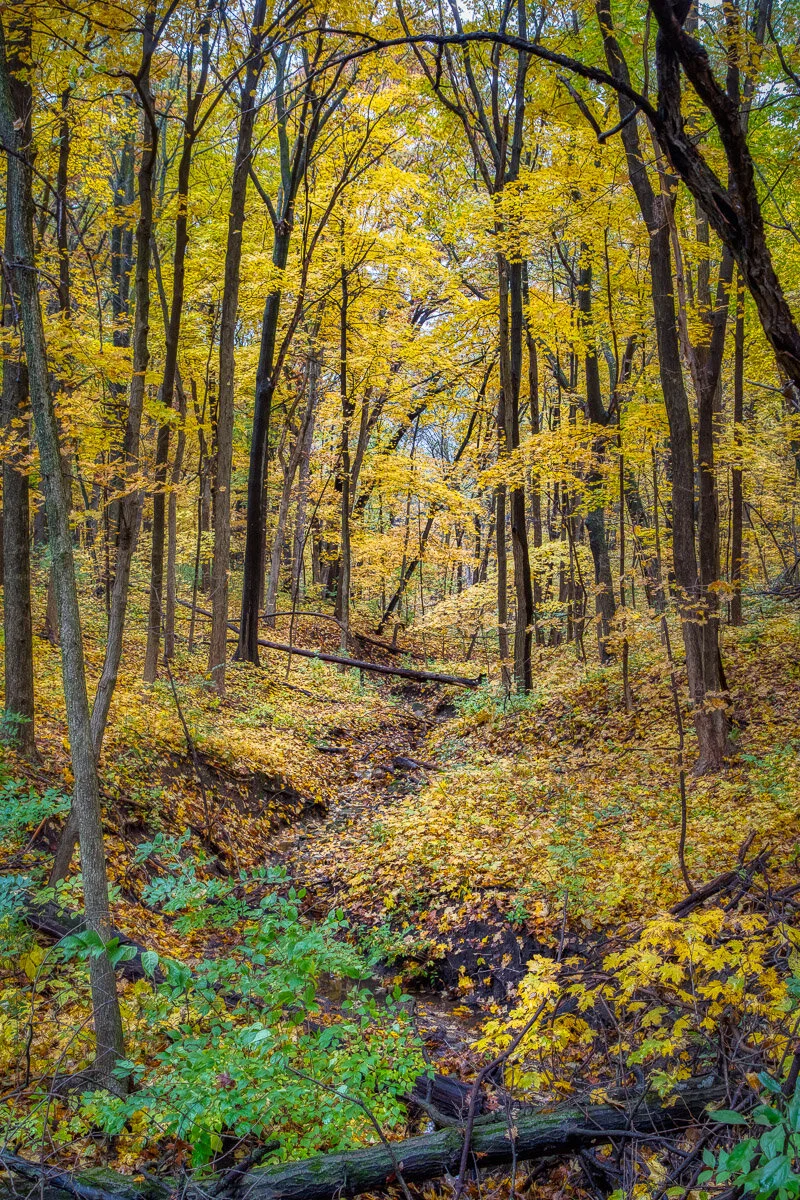
Tuesday morning was time for a walk through the autumn colors at Morton Arboretum before they all would fall. The primary color was the yellow of the maples.

A creek through the maples

A creek through the maples

Spotlight on the yellow maple

Spotlight on the yellow maple

The was a bit of orange and reds among the oaks, and a few others were enjoying the trails.

A walk among the maples frames by some oaks

A walk among the maples frames by some oaks

An old oak

An old oak

A single revolution and autumn changed to winter with a good snowfall the next morning. Some of the leafy branches weighted down with the wet snow broke off to the ground.

Paperbark hazelnut

Paperbark hazelnut

Winter oaks

Winter oaks

The trail led from the oak forest to the trees of China, and I traveled about a half century. When I was 9 or so, I wanted to be an archaeologist, and would show off my rock collection. A friend of my dad’s said he collected fossils. Then next time he visited, he gave me a small collection he labeled and mounted. The star was a ginkgo leaf which he told me was a living fossil. It lived before the time of the T. Rex and was still growing. Here was copse of ginkgos with their fan-shaped leaves turning gold.

Under the ginkgo trees

Under the ginkgo trees

Ginkgo window

Ginkgo window

The trees canopy and envelope each other, telling stories of the day, the season, or an epoch. And sometimes of a kindness done long ago.

Autumn umbrella

Autumn umbrella

Winter hugs

Winter hugs

Blue Horses

If I ever need to be delighted with language, art, heart, earth, hearth, I only need to read a Mary Oliver poem. Here are excerpts of four of her poems from her 2014 book Blue Horses, and some images from Scotland. Choosing only a few lines from a poem fails to convey all its wonder and craft, so it’s best to get the book and read the whole.

Glencoe stream

Glencoe stream

Stebin’s Gulch

by the randomness

of the way

the rocks tumbled

ages ago

the water pours

it pours

it pours

ever along the slant

. . . .

as for purpose

there is none,

it is simply

one of those gorgeous things

that was made

to do what it does perfectly

and to last,

as almost nothing does,

almost forever.

Loch Ness trail

Loch Ness trail

Drifting

I was enjoying everything: the rain, the path

wherever it was taking me, the earth roots

beginning to stir.

I didn’t intend to start thinking about God,

it just happened.

How God, or the gods, are invisible,

quite understandable.

But holiness is visible, entirely.

. . . .

Iona shoreline

Iona shoreline

Do Stones Feel?

Do stones feel?

Do they love their life?

Or does their patience drown out everything else?

When I walk on the beach I gather a few

white ones, dark ones, the multiple colors.

Don’t worry, I say, I’ll bring you back, and I do.

. . . .

Island of Mull

Island of Mull

Franz Marc’s Blue Horses

. . . .

I don’t know how to thank you, Franz Marc.

Maybe our world will grow kinder eventually.

Maybe the desire to make something beautiful

is the piece of God that is inside each of us.

Now all four horses have come closer,

are bending their faces toward me

as if they have secrets to tell.

I don’t expect them to speak, and they don’t.

If being so beautiful isn’t enough, what

could they possibly say?

3 Billion loss

Science magazine published a report last month that the bird population of the United States and Canada has declined by nearly 3 billion birds, or 29 percent, since 1970. Habitat loss and pesticides lead the causes. Grassland birds have suffered the steepest declines. It might just not being in the right place, but often at this time of year I’ve seen great murmurations of huge flocks of blackbirds and haven’t seen as many large groups in recent years.

Red-winged blackbird

Red-winged blackbird

European starlings were introduced to the U.S. in the 19th century and spread far and wide. The report found that even these birds declined nearly by half. Starlings look drab at a distance, but up close have impressive color as this fellow showed off on the Island of Mull.

European Starling

European Starling

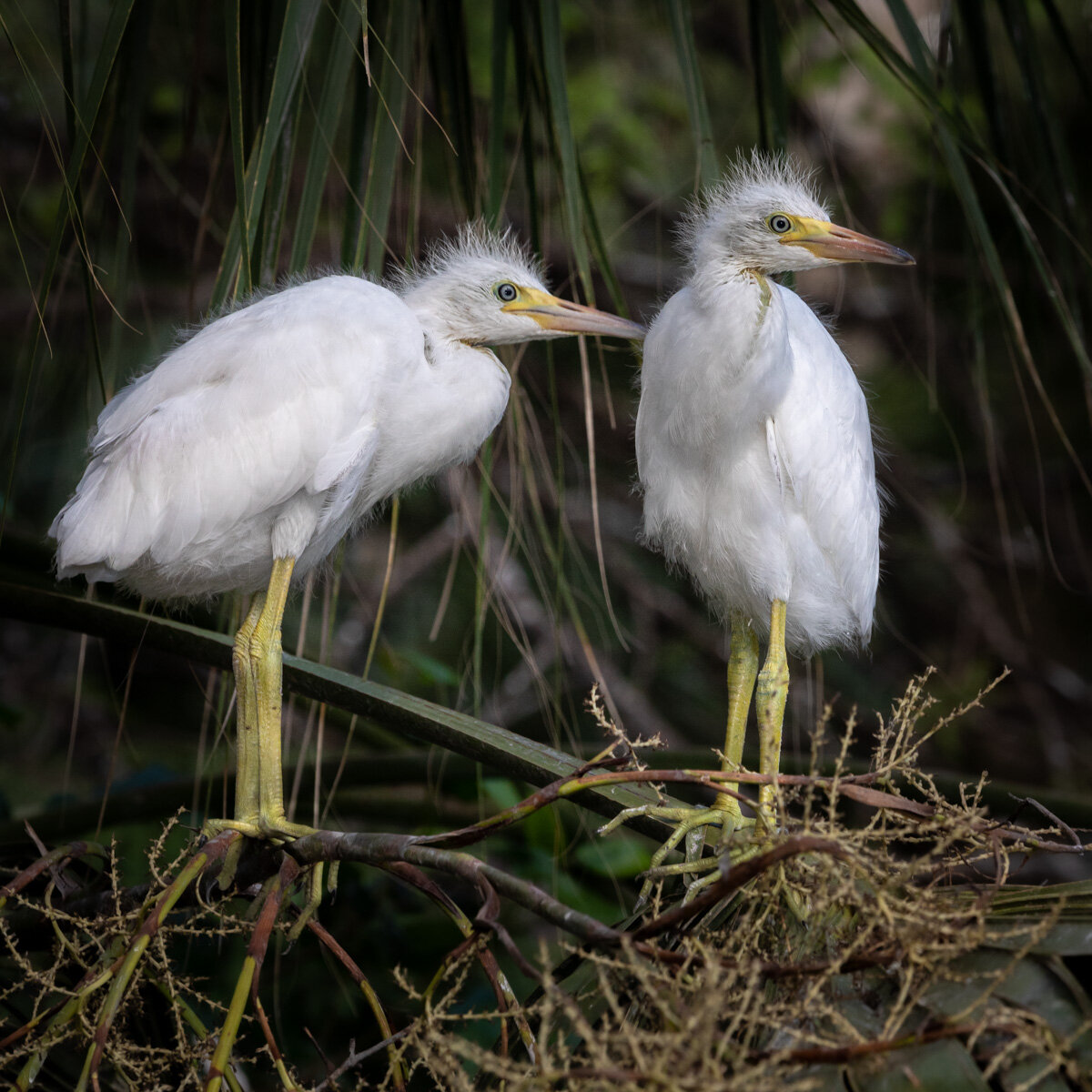
Cattle Egrets are another immigrant. They evolved following large animals in the grasslands of African. They spread to South America in the 19th century. By the mid-20th century they were in North America, and they were very common when I was growing up in Florida following cattle and the insects stirred up.

Cattle Egret chicks

Cattle Egret chicks

cattle egret chicks close-1296.jpg

And the birds aren’t the only ones with a wide mouth. Nests such as this are often over water which makes it harder for predators to get to the trees. However, if the chicks fall out they become a quick snack.

American Alligator

American Alligator

Audubon magazine also reports the devastating effect of climate change on bird range and habitats. Many species faced near extinction a century ago when their plumage was harvested for fashion. Many, like the Great Egret below, made a great recovery, and now face the risk of climate change and habitat loss.

Great Egret chick

Great Egret chick